In my previous post, Angry Autistics Part 1, I addressed parents, hoping to help them understand why some of us react with anger to their questions.
This second part is to address Autistic people in online forums, who are offering advice. While the vast majority are helpful, I believe we are getting fragmented within the community by those who react in much more aggressive ways. I have seen way too many Autistic people just drop out after being attacked by fellow Autistics.
Fact is, I don't believe aggressive behaviour, in any facet of life, moves people forward. It makes sense to be aggressive if being attacked. Self-defense has a place. However, I do not feel that the vast majority of the time anyone is really being attacked online to the point that it requires so much aggression.
While people are more likely to hear you if you are yelling at them, it won't make them want to listen to you for very long. I believe we need parents to listen, not just hear us, if we're going to make any headway for understanding.
I've been accused of tone-policing, and we can disagree on that. I simply think when people are calm, logical, measured and even, the doors of communication stay open longer. They might still close! That's a chance you always take, but you still can hope for the best. If things go well, even if the door closes, it might be opened again after some time.
One thing I think needs to happen is you need to give some of the many well-intentioned parents a second chance. Sometimes they need to sleep on it a few days or weeks to come around. If they're fighting you tooth and nail about something heinous, by all means, protect yourselves and ban them. But if they're slowly learning and sussing things out, asking questions and trying to understand, give them some time.
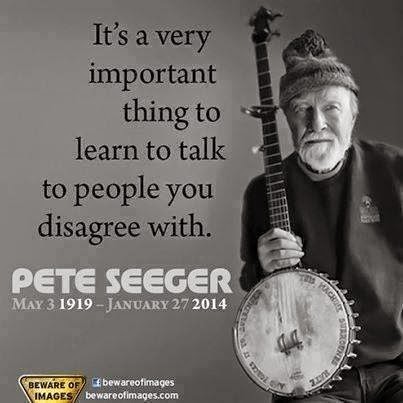 |
| "It's a very important thing to learn to talk to people you disagree with" - Pete Seeger |
The problem with responding with anger each time someone asks what they think is an innocent question, is you end up in a room with only people who agree with you.
That's cool, if that's what you want, but it's not cool if you want to enact change in others. Because they can't ever learn if you don't explain it to them.
It they don't get it the first time, try a second time. If they don't get it after that, then consider either communication is not working or they need to think. And yes, it can be frustrating. And yes, it requires patience. But yes, I promise it's worth it in the long run.
At the same time, people don't have to agree on every little thing in order to get along and work together for the greater good. There are grey areas sometimes and grey areas are ok. Work with what overlaps.
At the same time, people don't have to agree on every little thing in order to get along and work together for the greater good. There are grey areas sometimes and grey areas are ok. Work with what overlaps.
Please also keep in mind, I am not talking about people who blatantly troll, or derail threads ("if you cared, you would teach me") - I'm talking about the ones who you can send links to posts or books to and they will read them and think about it. Stick with the receptive ones and don't ostracize them.
I'm asking you to give strangers on the net, who know nothing about you, the benefit of the doubt. They are not your parents. They are not the guy who bullied you in third grade. If you only allow the people who ask questions you find acceptable, then you will eventually find no one is asking you questions. That's fine, you're not required by law to answer questions. In which case, don't pretend the intention of your community is to help EVERYONE. Tell people it's to help only those who already fit into your neat box of who you are willing to help so they can weed themselves out. That will make you a lot less aggravated and stop spreading the aggro around.
Accept that us Autistics often take things very literally and personally. I can't even count how many times someone has left a comment on my blog and I thought it was negative, but when (kindly and patiently) rephrased by the commenter, it was very positive. My misinterpretations are on me. I have limits. I accept them. So I need to ask others around me (usually NT) to get their opinions. I ask people whom I trust have my best interests at heart and have proven themselves so. Anything can be made into a mountain if you have a lot of angry people looking at the problem. Sometimes it was tone that threw me off. Sometimes it was words. It doesn't matter, and I believe intent doesn't matter, but sometimes you have to give the benefit of the doubt. In the end, it's about the kids, it's not about you. If you truly care about how the kids turn out, you have to keep the parents sweet on your side. You can do that without compromising your morals, beliefs and self, AND you can do it without being angry. It's true. I'm sure of it.
A lot of us actually don't have children of our own, and yes, that may sound ____ist of some sort, but it's true, it does make a difference. It doesn't mean no insight can be offered, but realistically, the only people who can speak of their experience with any authority should be those who actually live that experience. I would not expect a white person to speak for the black experience, nor would I expect a man to be able to speak about the female experience. Similarly, parenthood is something one has to live in order to really understand. So please don't act like you are a parenting expert because you were once a child. No matter how well-intentioned you are, or how much you think you know ("but my friend has a kid! That's totally the same!"), you cannot act as an authority to that experience.
Finally, please try to remember that some Autistics hold internalized hate or hurtful language and will say/write things, not because they are trying to insult you, but because that is all they know. Before I knew how awful Autism $peaks was, I supported people for their walks, because I did not know better. The way to teach someone, however, is not by calling them names or insulting their intelligence - the way to teach is with empathy and understanding - the same way many advocate we teach our children.
